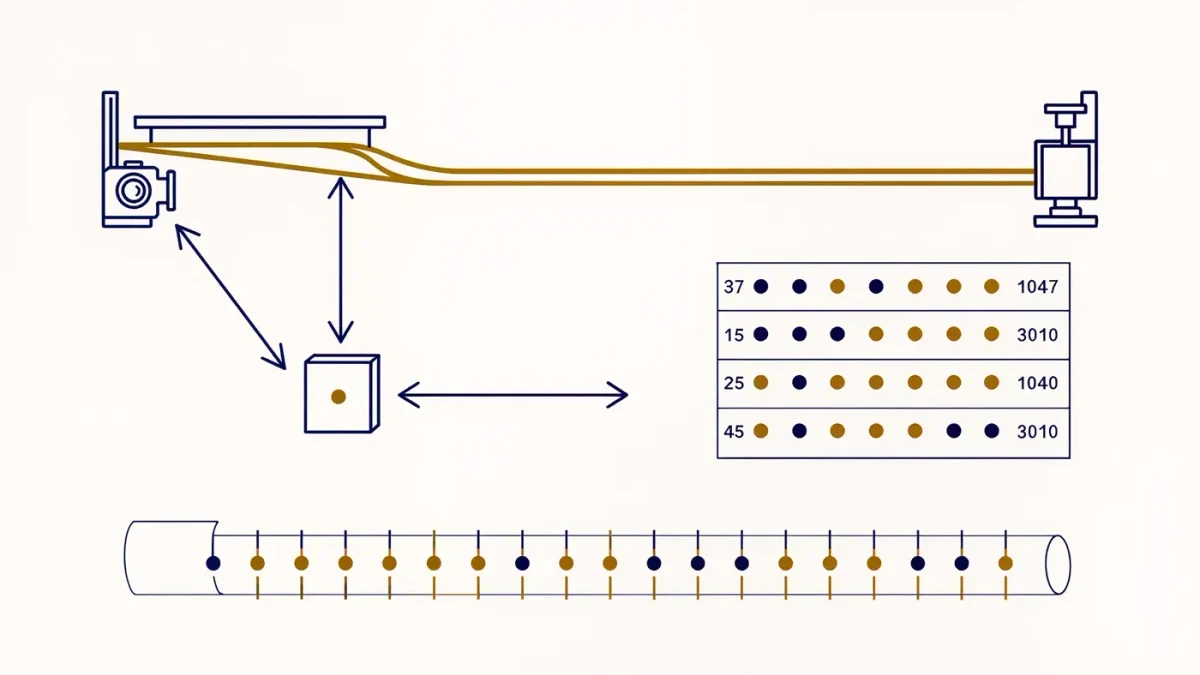
Machine vision inspection, in which line-scan cameras examine moving fabric and software flags defects in real time, inspects cloth at full production speed and never blinks; systems installed through the mid-2020s commonly reported detecting a large majority of significant defects at web speeds of tens of meters per minute, per vendor performance claims. The technology replaced a human inspector leaning over a moving roll, whose attention measurably decayed within minutes. What it did not replace is judgment: deciding whether a defect ruins a first-quality cut or hides inside a wastage allowance remains a policy question that software only partially answers.
What is machine vision inspection on a fabric line?
The hardware is simple in outline: one or more line-scan cameras, which capture an image strip as the fabric passes a frame, illuminated by controlled LED or laser light aimed to make defects visible. The software receives the strips, compares each against a learned model of the fabric's normal appearance, and marks any anomaly with its position along the roll. A defect map, the record of every flagged flaw with type and location, accompanies the roll downstream.
Defect taxonomy matters here, because the industry grades fabric on it. The classic American system assigns demerit points per defect by size, and the four-point system, the grading method that scores defects by their measured length and totals points per hundred square meters, remains the trade's common contract language. Vision systems exist, in commercial terms, to automate both the finding and the scoring.
What kinds of defects does it actually catch?
Performance splits by defect physics. High-contrast, structured flaws show up well; low-contrast and textural flaws remain hard. Typical capability as of the mid-2020s ran as follows.
- Detected well: knots and slubs, broken picks and ends, holes, thick yarn, foreign fibers, oil stains, obvious weaving errors such as misdraws.
- Detected inconsistently: subtle shade variation across the width, faint barré stripes, small recurring pattern repeats errors in jacquards.
- Largely out of reach: hand-affecting flaws invisible to the camera, and aesthetic judgments such as whether a slub suits the fabric's intended character.
Illumination engineering drives much of the difference. A defect visible under raking light may vanish under diffuse light, so serious installations tune lighting per fabric construction and re-tune when the mix changes. A vision line moved from denim to voile without reconfiguration performs poorly, a limitation buyers routinely discover after purchase.
How does the detection pipeline work?
Regardless of vendor, the processing sequence follows the same five steps, and understanding it explains both the strengths and the failure modes.
- Image capture: line-scan cameras photograph consecutive strips of moving fabric, synchronized to line speed so the strips tile into a full image.
- Preprocessing: software normalizes brightness and contrast, compensating for illumination drift and fabric edge effects.
- Anomaly detection: each region is compared against a reference model of correct appearance, using trained classifiers that learn each fabric's normal texture.
- Classification: flagged anomalies are sorted into defect types, which determines their demerit points under the grading standard.
- Mapping and disposition: defect positions are logged on the roll map, and the system proposes cutting or demotion decisions for downstream confirmation.
Step three is where the engineering effort and the patents concentrate. Early systems matched the image against a golden reference, which failed on natural fabric variation; modern systems learn each lot's normal appearance and flag departures from that lot, which handles variation better but needs retraining per fabric change.
Related stories: 3D Sampling Can Shrink Development Calendars, but It Has Not Replaced the Physical Sample · Laser Finishing Replaces Stone Washing's Water and Chemicals One Finishing Plant at a Time.
How does it compare with human inspection?
The honest comparison is between two different failure profiles, summarized below.
| Attribute | Human inspector | Machine vision system |
|---|---|---|
| Speed | Limited by attention and roll handling | Full production speed, per vendor specifications |
| Consistency | Declines over a shift; varies between inspectors | Stable across hours; varies between fabric settings |
| Small high-contrast defects | Frequently caught at slow speeds | Caught reliably when tuned |
| Low-contrast textural defects | Superior, using touch and experience | Inconsistent without careful lighting |
| Grading judgment | Applies context and customer priorities | Applies configured rules only |
Most serious installations through 2025 therefore kept a human in the loop at reduced staffing: the machine finds and maps, and a person adjudicates borderline calls and handles fabric changes. Fully dark inspection rooms without human oversight exist for commodity fabrics with stable construction, not for fashion textiles.
What does an installation cost?
Published pricing is sparse because configurations vary with web width, line speed, and fabric mix, but industry discussion has generally placed complete inspection systems for weaving or finishing lines in the range of tens of thousands to low hundreds of thousands of dollars, per vendor quotations reported in trade press. The hidden costs are lighting reconfiguration per fabric family, classifier retraining, and false alarm management, since an over-sensitive system floods operators with flags and erodes trust faster than a missed defect does.
Why does this matter downstream in garments?
Because fabric quality contracts are written in defect points, and enforcement has always depended on inspection effort. A garment factory receiving machine-mapped rolls can plan cuts around defect locations, moving a flagged flaw into the cutting wastage instead of into a front panel; research on fabric utilization and defect mapping has shown real recoverable percentages when cut planning reads inspection data, and textile engineering programs, including work associated with North Carolina State University, have studied automated inspection and cut planning for decades.
Contracts between mills and garment customers increasingly specify that the roll map accompany the fabric as a condition of the quality certificate, which turns the inspection system's log from an internal tool into a commercial document. The buyer's practical standard as of early 2026: accept vendor detection claims only for defect classes demonstrated on your own fabric constructions, demand the roll map as a deliverable alongside the roll, and budget for the human judgment layer that the cameras still require.
How do false alarms and missed defects trade off?
Every detection system operates on a threshold, and the threshold sets the plant's daily experience. Set sensitivity high and the system flags natural fabric variation as defects, flooding operators with false alarms; within weeks the team learns to clear flags without inspection, and genuine defects pass under a blanket of noise. Set sensitivity low and the system stays quiet while real defects slip through, which the customer discovers. Tuning is therefore an ongoing operational task tied to each fabric construction, not a commissioning checkbox.
The economics of the two errors are asymmetric. A missed defect escapes to the garment factory and surfaces as a claim, a demoted roll, or an unplanned marker change, with costs measured in margins and reputation. A false alarm costs an operator minute and erodes trust, which is corrosive but recoverable. Plants generally run slightly sensitive and invest in the adjudication step, accepting human review as the price of low escape rates.
Reporting discipline determines whether tuning improves. Systems log their flags, but the useful metric is the ratio of confirmed defects to total flags per fabric, tracked over time, and the plants that review that ratio weekly hold detection quality steady while fabric mixes change. Those that tune once at installation and never revisit quietly drift, and the drift only becomes visible when a customer's inspector disagrees with the mill's grade on an incoming roll, an argument the roll map either settles or escalates.