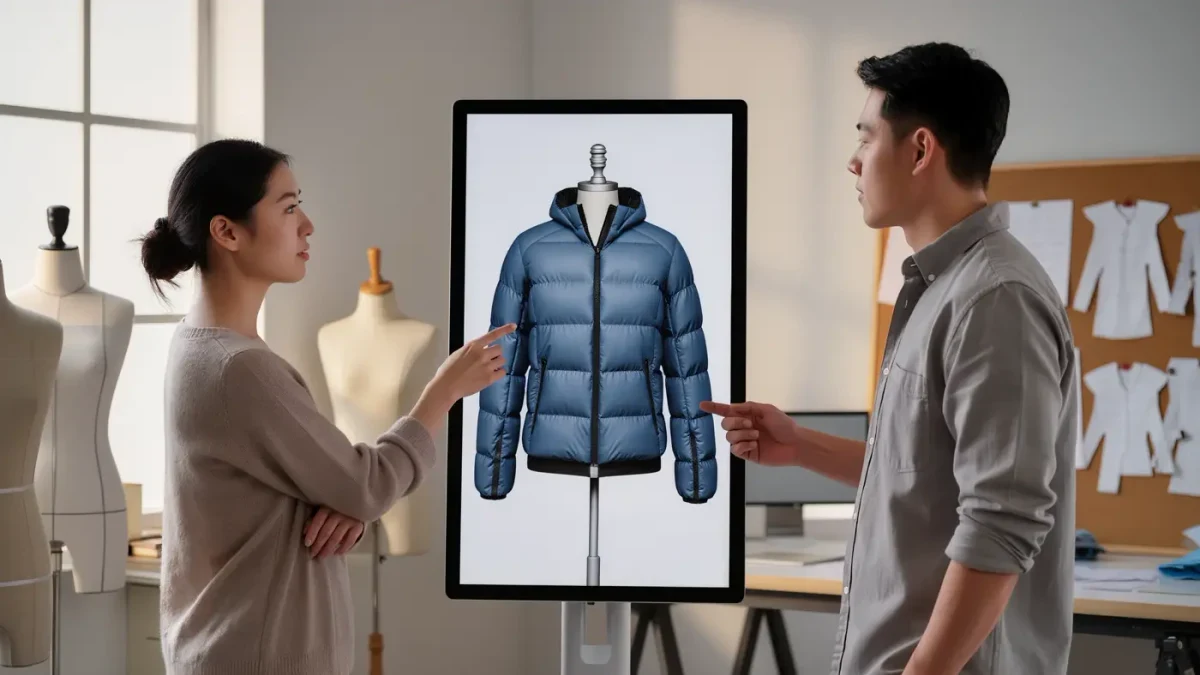
3D sampling replaces most, not all, physical prototypes: by 2025, brands using tools such as CLO 3D, Browzwear, and Style3D typically collapsed three or four proto rounds into one, but nearly every apparel product still ended with a sewn sample before bulk production. The digital garment, a simulation of cloth behavior built on measured fabric physics, handles silhouette, seam placement, and pattern corrections cheaply. The physical sample, sewn in the intended fabric, remains the court of appeal for hand feel and true drape. The question is not whether 3D wins, but at which development stage it wins.
What exactly is a 3D sample?
A 3D sample is a garment assembled in software from the same pattern pieces used for cutting, stitched together virtually over a parametric avatar. The system, often called a 3D garment simulation platform, applies fabric physics parameters to each panel so the digital cloth bends, stretches, and folds in a way that approximates reality. The output looks like a photograph of a finished garment and behaves like one when the avatar moves.
The critical input is not the pattern but the fabric card. Each textile must be physically tested on instruments that measure bending rigidity, stretch, weight, and thickness, and those measured values, not visual guesses, drive how the simulation drapes. A brand that skips physical fabric testing produces attractive renders that lie about fit. This single dependency explains most failed 3D programs.
How does a 3D sampling workflow actually run?
The sequence below reflects how a typical development team operates once the toolchain is in place, running from tech pack data through a final sealed sample.
- The pattern maker exports the flat pattern from the CAD system, including seam allowances and notches, into the 3D environment.
- A tested fabric card with measured physics parameters is assigned to each panel, and trims such as zippers and ribbing are placed from a digital library.
- The garment is virtually stitched and simulated on an avatar sized to the brand's fit block, and the maker reviews balance, ease, and drape on screen.
- Comments are returned to the pattern in the same cycle, often within hours, and the corrected version is re-simulated the same day.
- When the digital garment passes review, a single physical proto is cut and sewn in the intended fabric to confirm hand, weight, and construction before the size set.
Steps one through four cost close to nothing in materials and can repeat several times in a week. Step five is where money and calendar time are spent, which is why the ratio of digital cycles to physical ones defines the program's savings.
Does 3D really cut the sample count?
Vendor case studies and published brand accounts through 2024-2025 consistently describe reductions from two or three physical protos per style to one, with the digital rounds absorbing the iteration. The saving is not uniform across categories. Knit tops and simple woven bottoms, where fabric behavior is predictable, convert to digital review almost completely. Tailored jackets, outerwear with internal engineering, and anything depending on interlining behavior still demand physical confirmation because simulation of fused and multi-layer construction remains approximate.
Calendar effects are often larger than sample-count effects. A physical proto round in a global supply chain typically consumes two to four weeks including shipping; a digital round consumes days. Removing two rounds from that loop pulls weeks out of development, which matters more than courier bills for teams working compressed seasonal calendars.
Where does 3D sampling fail?
Simulation has known blind spots, and teams that trust it beyond its accuracy pay for the error in bulk. Fabric hand cannot be rendered because it is a tactile property; a slubbed linen and a smooth viscose with identical physics parameters would look different in person but behave the same on screen. Drape under real gravity is approximated, not solved, and heavy or fluid fabrics show the largest deviation. Fit on a moving body is another gap, since avatars pose but do not strain, ride up, or shift the way wearers do.
There is also an organizational failure mode: brands that buy licenses without funding fabric testing labs and pattern maker retraining end up with renders used for marketing while development continues as before. Research programs at institutions such as North Carolina State University's Wilson College of Textiles have stressed for years that the measurement infrastructure, not the software license, is the binding constraint.
Related stories: Machine Vision Now Inspects Fabric at Full Speed, and It Still Misses Like a Human · Body Scanning Gave Apparel Real Population Data, and Brands Still Barely Use It.
What does the technology cost?
Per-seat license fees for the leading 3D garment platforms have generally run in the range of a few thousand dollars per designer per year, per the vendors' published pricing communications, with enterprise agreements negotiated separately. The larger line items are the fabric digitization equipment, which spans a wide band from budget camera-based capture systems to laboratory-grade instruments, and the labor of building a fabric card library. A mid-size brand typically budgeted a one- to two-year payback horizon based on avoided sample costs and air freight, though few published audited figures.
Who is using it, and to what degree?
Adoption has stratified into three patterns, summarized below, and the differences map closely to product complexity and supply chain distance.
| Adoption tier | Typical user | Physical protos per style | Primary use of 3D |
|---|---|---|---|
| Full digital development | Sportswear and basics brands with long supply lines | 0 to 1 | Fit decisions and internal approvals on screen |
| Hybrid | Mid-market brands across most categories | 1 to 2 | Early rounds digital, final proto physical |
| Visualization only | Fashion-led labels with complex products | 2 to 3 | Renders for line reviews and sales, not fit |
Sportswear groups moved first because their fabrics are engineered and measured anyway, giving them accurate fabric cards at scale. Fast-fashion majors adopted 3D to shorten the loop between trend identification and production commitment. Smaller fashion labels often stop at visualization because tailored construction exposes simulation's limits.
Will the physical sample ever disappear entirely?
Not for most products in the near term, and the honest framing is that the physical sample has been repositioned rather than eliminated. It now seals decisions already made digitally instead of discovering them. Two developments could push further: better coupling between measured fabric data and simulation engines, which narrows the drape gap, and fit data from real bodies, which substitutes for some on-body review. Both were active research areas through 2025, with textile engineering programs and standards bodies such as NIST's manufacturing work touching the underlying measurement science.
The practical answer for a brand planning its 2026 development calendar is to treat 3D as the default review medium for silhouette, proportion, and pattern corrections, and to reserve the physical sample for hand confirmation and the final seal. Teams that invert this order, or that skip fabric measurement, recover neither the samples nor the weeks.
How does a brand build the fabric library that simulation trusts?
The fabric card library is the asset that separates a working 3D program from a decorative one, and building it is a measurement campaign rather than a software exercise. Every fabric in the development range needs instrument testing for weight, thickness, bending rigidity, and stretch behavior, and the resulting parameters must be validated against a physical drape test before anyone trusts the render. Teams that migrated from camera-based capture shortcuts to instrument-grade data consistently reported the largest accuracy gains, because visual capture records appearance while simulation consumes physics.
Maintenance is the neglected half of the work. Mills reformulate fabrics, weights drift between lots, and a card created three seasons ago may no longer describe the fabric the factory actually ships. Brands that audit their libraries quarterly keep simulation trustworthy; brands that treat the library as a one-time project watch accuracy decay silently until a fit failure forces a review. Assigning ownership of the library, typically to a materials or technical design role, is the single cheapest program decision with the largest downstream effect.
Scale matters for the economics. A brand testing a few hundred fabrics a year can justify laboratory instruments; a brand testing a few dozen may share testing capacity through service labs or supplier-provided cards. Supplier-provided data introduces its own risk, since a mill's enthusiasm for a parameter is not a measurement, and unverified cards have been a recurring source of overconfident renders. The pattern that survives is simple: measure what you cut, record what you measured, and re-measure what changed.