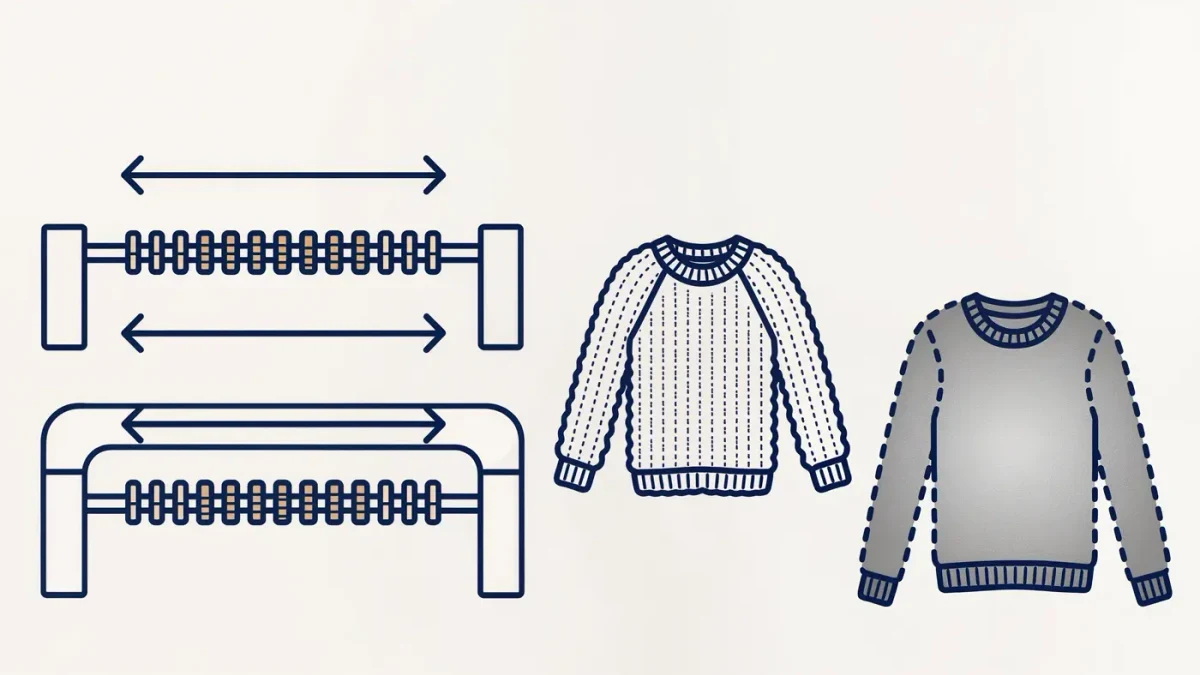
Whole-garment knitting, a technology commercialized industrially by Japan's Shima Seiki under the WHOLEGARMENT name and paralleled by Germany's Stoll under knit-and-wear, produces a complete garment on the machine in one knitting cycle, requiring no linking, no sewing, and no cut-and-sew waste; Shima Seiki, the method's best-known proponent, has stated for years that conventional cut-and-sew discards a meaningful share of fabric as offcuts that whole-garment eliminates by construction, per the company's published materials. The result enters the world as a finished sweater straight off the machine, requiring only a wash and finish. What it costs, and what it cannot yet knit, defines the niche.
What does one knitting cycle actually produce?
The machine, a computerized flat knitting system with two needle beds and loop-transfer capability, builds the garment in three-dimensional segments that merge as they knit: two sleeves, a body tube, and shoulders formed continuously, with the neck opening created by knitting structure rather than by cutting. The technology that makes this possible is loop transfer, in which loops move between needles and beds so the fabric can change direction and shape without being cut from a panel.
The garment leaves the machine without side seams, shoulder seams, or armhole seams. For knitwear wearers this is a comfort claim with substance, because seam ridges are a primary contact irritation in conventional sweaters, and published product literature from both machine makers has traded on seam-free construction for decades.
How does the process differ from cut-and-sew knitwear?
The conventional and whole-garment pipelines diverge immediately after yarn selection, and the difference shows up in labor, lead time, and waste.
- Conventional: panels are knitted flat to shape or knitted as continuous yardage, then cut; cut panels travel to linking, in which a skilled operator joins panels loop by loop on a linking machine, then to seaming, trimming, washing, and pressing.
- Whole-garment: the programmed garment is knitted complete in a single machine pass lasting roughly thirty to ninety minutes for a typical sweater, per vendor process descriptions, with duration varying by complexity and gauge.
- Conventional output then depends on sewing-room labor pools; whole-garment output depends on machine availability and programming skill.
- Waste differs by construction: whole-garment generates no cutting offcuts by design, while cut-and-sew operations discard shaped offcuts that industry reporting has commonly placed in the twenty to thirty percent range for some shaped knit products, with the figure varying heavily by style.
Both routes end in wet finishing. A whole-garment sweater still washes, blocks, and presses like any knit; the seam-free claim concerns construction, not finishing. Fashion reputations have been made on that distinction, because wearers judge knitwear by what touches the skin, and a shoulder without a ridge changes the daily experience of a garment more than most design decisions do.
What are the design constraints?
The method's limits are structural, and they explain the product niche. Fine gauges suit it best; the technique excels at mid-to-fine gauge sweaters and accessories where the machines' stitch control shows. Highly tailored knit constructions, heavy outerwear weights, and garments needing woven fabric components sit outside it. Colorwork and complex intarsia are possible but slow and programming-intensive, and each design demands machine program code, a discipline closer to software development than to conventional pattern drafting. Designers work through the machine maker's design systems, notably Shima Seiki's SDS-ONE platform, and the programming skill, not the knitting, is the industry's acknowledged bottleneck.
There is also a dimensional constraint. Garments knit as tubes take the body's shape from the knit structure itself, so fits that depend on sewn shaping, darts, or dense stable panels translate awkwardly. Fashion knitwear houses using the technology, including several Italian and Japanese luxury names that adopted it from the 2000s onward, design expressly for the machine rather than converting existing silhouettes.
Related stories: Digital Textile Printing Costs More Per Meter, and Wins on Everything Else · PLM Software Tracks a Garment From Sketch to Invoice, Line by Auditable Line.
What does the equipment cost, and who runs it?
Industrial whole-garment machines have carried prices reported in industry coverage in the range of tens of thousands of dollars per machine to substantially more for wide-gauge configurations, per vendor and trade reporting, and a production cell requires multiple machines because a single machine produces roughly a sweater per hour rather than per minute. The economics favor producers who can keep machines loaded with varied, higher-margin product; a factory knitting one commodity sweater in millions of units still wins on conventional high-speed lines.
| Factor | Cut-and-sew knitwear | Whole-garment knitting |
|---|---|---|
| Cutting waste | Shaped offcuts discarded | Eliminated by construction |
| Labor dependence | Linking and sewing rooms | Machine operators and programmers |
| Output per machine | Panels feeding multi-station assembly | Roughly one garment per machine-hour |
| Lead time for a new design | Sampling across knit, cut, and sew stages | Program once, knit samples directly |
| Suitable products | Broad, including heavy and tailored knits | Mid-to-fine gauge sweaters, dresses, accessories |
Why does the method matter for on-demand production?
Because sample and small-run economics favor it. A design that exists as machine code produces a sample in the same process as production, with no sample-room round trip, which is why the technology appears repeatedly in on-demand and made-to-order knitwear proposals through the 2020s. Shima Seiki's own published advocacy frames the method as aligning production with demand, knitting to order rather than knitting to forecast, and academic work on apparel sustainability, including research from textile programs such as North Carolina State University's, has examined whole-garment knitting's waste and lead-time advantages in exactly that frame.
The summary position as of mid-2026: whole-garment knitting is a mature, proven technology with a real but bounded territory, strong wherever seam-free comfort, zero cut waste, and small-lot flexibility carry the margin, and absent wherever commodity volume, heavy gauge, or sewn construction defines the product. Brands considering it should budget for programmers before machines, since the programming desk, not the knitting floor, is where the method's queue forms.
How does machine programming differ from conventional pattern drafting?
The programmer's file is not a pattern in the tailoring sense but a knitting instruction sequence, specifying stitch types, loop transfers, and carriage movements course by course, and the whole garment exists in the code before it exists in yarn. Conventional pattern drafting outputs shaped panels for other people to join; whole-garment programming outputs a build plan the machine executes alone. The mental shift is from pieces to process, and experienced drafters describe a learning curve of months before their design instincts translate into machine logic.
Design systems mediate the work. Shima Seiki's SDS-ONE platform and Stoll's equivalent software provide libraries of garment templates that a programmer adapts, which is how production keeps pace despite the skill bottleneck: most commercial styles start from a proven structural base with modified dimensions, gauges, and stitch patterns rather than from blank code. Truly novel constructions, the kind that win design awards, consume programmer weeks and belong to the handful of programs that can afford the experimentation.
Staffing implications follow directly. A whole-garment production cell needs a programming desk with more scarcity value than the knitting floor, and factories have competed for programmers the way pattern rooms once competed for graders. Brands adopting the technology in-house discovered the same hierarchy: the machine purchase is the smaller commitment, and the sustainable advantage accrues to teams that train programmers internally and retain them, because the garment library they accumulate, tested structures and calibrated doses of shaping, is the asset competitors cannot buy.