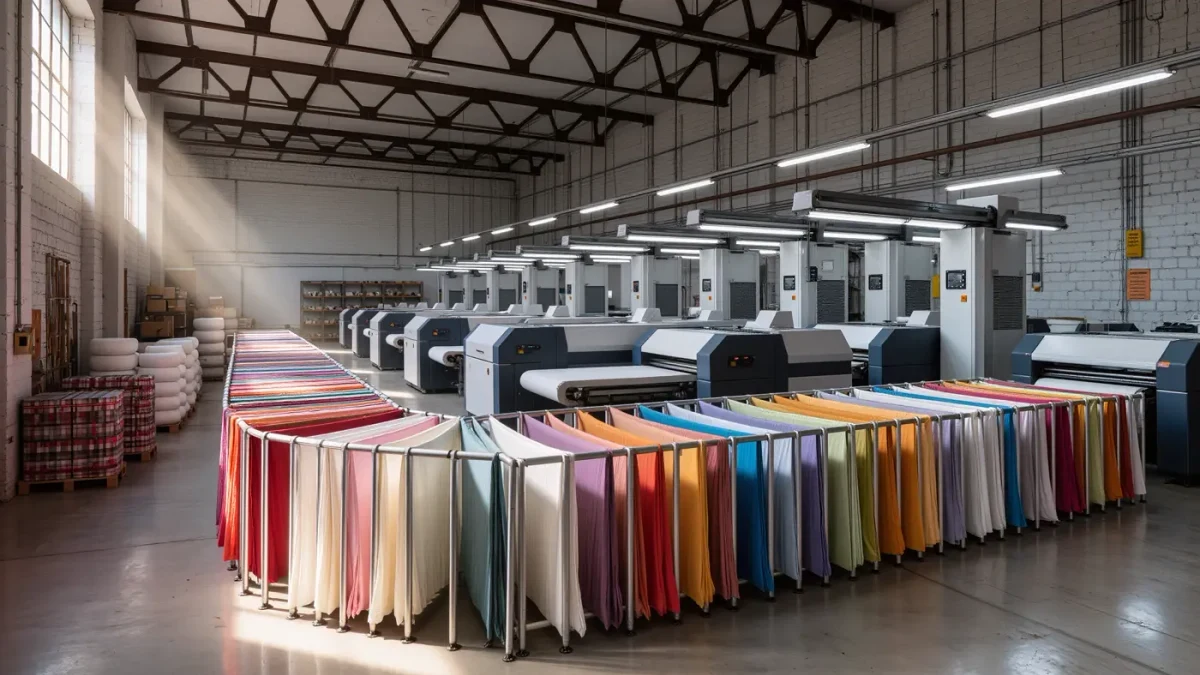
Digital textile printing, which is an inkjet process that deposits ink directly onto fabric from digital files without screens, still costs more per meter than rotary screen printing at volume; industry cost comparisons through the mid-2020s generally place digital ink expense per meter well above rotary's amortized screen cost at long runs. The economics reverse below a few hundred to a few thousand meters per design, because rotary printing carries screen engraving costs, a one-time charge per colorway per design, that digital simply does not have. The crossover point, not image quality, decides which technology a printer should load.
How do the two printing technologies differ?
Rotary screen printing, the volume technology that dominated yardage production for decades, pushes ink through engraved cylindrical screens, one screen per color, at speeds of tens of meters per minute. Its strengths are speed and low ink-related cost per meter at volume; its weaknesses are screen costs, color limits per design, long setup, and minimum run sizes that make short runs expensive on a per-meter basis.
Digital printing sprays reactive, disperse, pigment, or acid inks through piezoelectric printheads steered by the design file. Setup is a color-profile job measured in minutes. Speeds are far lower than rotary's, historically a few meters to a few tens of meters per minute depending on machine class and resolution, per vendor specifications. Ink is the dominant cost line, and pretreatment plus post-fixation washing apply for reactive and acid chemistries, adding water and energy that pigment workflows mostly avoid.
What actually drives cost per meter on each side?
The cost structures barely overlap, which is why the comparison is about run length before anything else.
| Cost element | Rotary screen printing | Digital printing |
|---|---|---|
| Setup per design | Screen engraving per color, plus strike-off cycle | File preparation and color profiling only |
| Ink or colorant | Low-cost print pastes | Encapsulated inks at a multiple of paste cost |
| Speed | Tens of meters per minute | Low single digits to low tens, per vendor datasheets |
| Waste at start of run | Meters of setup spoilage per colorway | Minimal; first meters are usually sellable |
| Inventory consequence | Encourages long runs and stock of printed yardage | Enables print-on-demand and repeat orders in short steps |
On a long, single-colorway order, rotary wins decisively: screens amortize to pennies per meter and the machine's speed dominates. On a twelve-meter sample, a fifty-meter capsule, or a reordered design split across three colorways, digital wins because there is nothing to amortize. Between those poles lies the crossover band, and published industry analyses during the 2010s and 2020s consistently described it as shifting upward for digital as ink prices fell and printhead productivity rose, while remaining real rather than eliminated.
Where is the crossover, roughly?
No honest single number exists, because ink cost, fabric value, number of colors in the design, and screen engraving tariffs all move it. The commonly cited order of magnitude in industry discussion through the mid-2020s was that designs running a few thousand meters or more per colorway belonged on rotary, designs in the tens to hundreds of meters belonged on digital, and the contested middle depended on the printer's own cost model. A printer deciding rationally computes, for each design, the point where screen cost per meter falls below the digital ink premium per meter, and no vendor datasheet can do that computation for them.
Related stories: Laser Finishing Replaces Stone Washing's Water and Chemicals One Finishing Plant at a Time · Whole-Garment Knitting Produces a Finished Sweater in One Cycle, With Catches.
What does the total cost of a print run include?
Per-meter ink comparisons flatter digital by omitting workflow and flatter rotary by omitting inventory. A fair accounting counts the items below on both sides.
- Design-to-strike-off time: rotary requires screen engraving and a physical strike-off, a trial print sent for approval, often adding days to weeks; digital produces a sellable first print within hours of file approval.
- Setup spoilage: each rotary colorway change consumes meters of fabric and paste; digital's start-up waste is close to nil.
- Chemistry and water: reactive and acid digital printing demand pretreatment and washing-off; pigment digital and rotary paste systems differ in their finishing burdens.
- Capital: rotary lines are heavy industrial investments; digital machine classes range from entry machines to industrial single-pass systems priced far higher.
- Inventory risk: unsold rotary-printed yardage is dead stock, and this hidden cost is the largest argument for digital in fashion ranges.
When unsold inventory is priced into the comparison, digital's premium per meter frequently disappears on fashion goods, where forecast error is high. On commodity basics with predictable demand, the inventory argument weakens and rotary's speed wins again.
Who is printing digitally, and for what?
Three commercial patterns dominated through 2025. Sampling and strike-off replacement came first everywhere: digital produces the salesman sample and the photo-typing without waiting on screens, which compressed development calendars across the printed-goods trade. Short-run fashion printing, including on-demand production for independent labels, is the second, and it is the segment where digital is the primary technology rather than the supplement. High-volume home textiles and apparel yardage remain rotary territory, with digital making inroads only where design counts explode or where retailers accept shorter replenishment runs.
Geographically, industrial digital capacity concentrated in the same printing hubs that already ran rotary volume, notably in Turkey, Portugal, Italy, India, and China, allowing print houses to route each job to whichever technology fits its run length. Textile chemistry research published through journals such as Nature-family outlets and academic textile programs continued to push ink cost and fixation efficiency, the two variables that most directly move the crossover.
Will digital eventually print everything?
Not on current chemistry and speed trends for long-run commodity yardage. The per-meter ink premium shrinks each year, but rotary's speed advantage scales with volume and does not shrink. The realistic end state, as of early 2026, is a stable division of labor: rotary for the volume middle of the market, digital for everything short, fast, or variable, and the crossover band as the true competitive frontier where print houses win or lose margins on their cost modeling discipline.
How do ink chemistries change the cost comparison?
The digital-versus-rotary question is really four questions, one per ink class, because chemistry determines the finishing burden. Reactive inks, the standard for cellulose fibers such as cotton, require pretreated fabric and thorough washing-off after fixation, adding water, energy, and process time to every meter. Acid inks behave similarly on silk and nylon. Disperse inks for polyester can sublimate directly, avoiding wash-off in transfer applications, which makes polyester the cheapest fiber to print digitally in some configurations.
Pigment inks changed the calculation during the 2010s and 2020s. Because pigment binds to the fiber surface with a binder and needs minimal or no pretreatment and no wash-off, pigment digital printing removes most of the water burden that made digital less attractive on sustainability grounds. Trade reporting through the mid-2020s described pigment as the fastest-growing digital ink class, with the trade-off being hand feel and durability that reactive chemistry still beats on certain fabrics, per printer trials.
For a cost model, the chemistries therefore sort differently than a simple per-meter ink price suggests. Reactive digital competes with rotary on quality-sensitive cotton goods where washing infrastructure already exists. Pigment digital competes on short runs and on any calculation that prices water, which is increasingly the case where finishing plants face effluent limits. The crossover band between the technologies is not one number but one number per ink class per fabric, and print houses that model it that way route orders more profitably than those that quote a single internal rate.