A returned shirt is not a refund but a second supply chain in reverse. One garment collects an estimated $10-$25 in direct costs before resale — reverse freight, sorting, inspection, restoration, and the markdown that often follows. According to reverse-logistics analyses through 2025, roughly two-thirds of returns resell at full price; the rest absorbs losses that dwarf its handling bill.
What happens when a return parcel arrives?
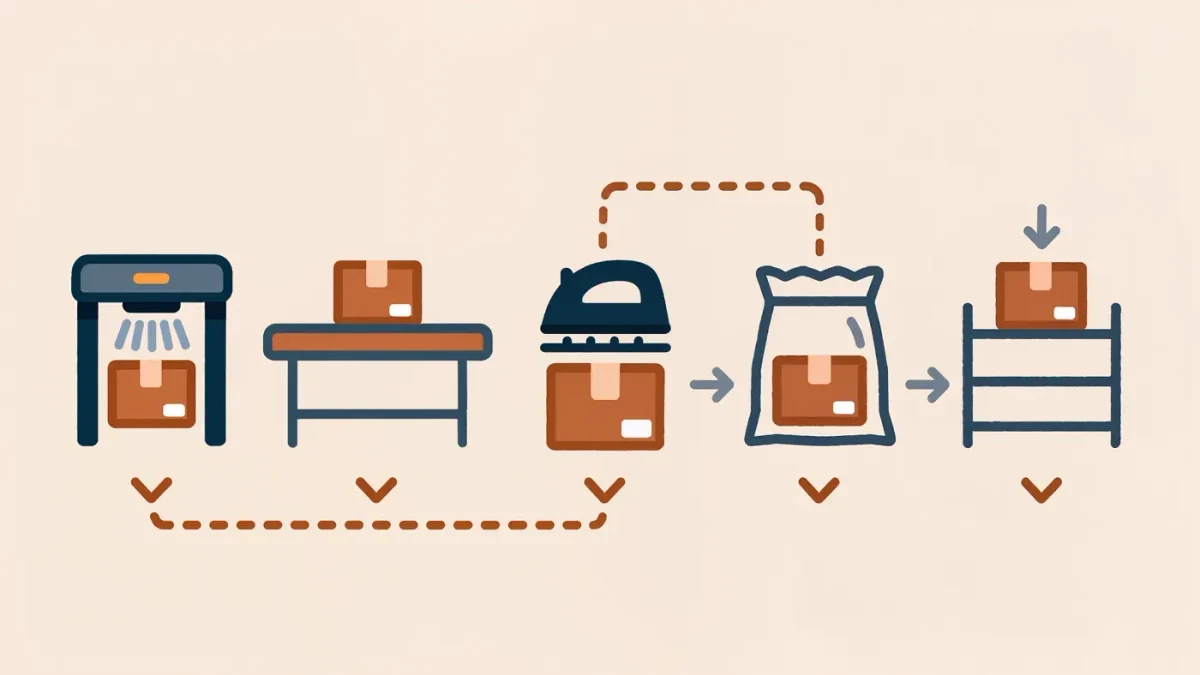
The route from doorstep to resale shelf passes through a fixed sequence, and each stage bills the operation:
- Receiving: the parcel is logged, matched to its original order, and queued for inspection. Labour cost begins at the scan.
- Triage: the garment is assessed for condition — tags attached, worn, washed, damaged, or contaminated. Only here does the retailer learn what it actually got back.
- Disposition: the item is routed to restock, repair, outlet, donation, or destruction. The routing decision is the most financially consequential moment in the chain.
- Restoration: steaming, re-tagging, re-bagging, and re-labeling, each a labour line and a materials line.
- Re-listing or transfer: the unit re-enters sellable inventory online or moves to a physical channel, incurring freight again.
Estimates put the labour for this cycle at eight to fifteen minutes per garment in an automated centre, and higher where inspection is manual. At a loaded warehouse labour rate, that alone is several dollars before freight is counted. retail coverage.
Where does the money actually go?
The per-unit cost stack breaks into five components, with ranges that vary by retailer scale and automation:
| Cost component | Estimated range per unit | Notes |
|---|---|---|
| Return shipping | $4–$9 | Label cost plus parcel handling; higher with paid-label abuse |
| Processing labour | $3–$7 | Receiving through restoration, automation-dependent |
| Packaging and materials | $0.50–$2 | Poly bags, tags, tape, most of it single-use |
| Markdown exposure | $0 or a large share of margin | Two-thirds resell at full price; the rest do not |
| Refund fraud and abuse | Low average, fat tail | Wardrobing, empty-box, and receipt fraud pooled across units |
The markdown line is the decisive one. A returned garment that restocks invisibly costs the retailer perhaps $8 to $15 in cash. A garment that comes back worn, or out of season, or to a channel that cannot sell it, converts its full wholesale cost into loss on top of the handling bill. This is why per-return averages understate the problem: the cost distribution is heavily skewed, and the tail units carry the real story of the channel.
Related stories: Fit Prediction Tools Are Quietly Reshaping the Apparel Return Rate · Markdown Cadence: Who Decides Price Cuts and on What Calendar.
Why does the free returns model struggle?
Free returns were priced as a marketing expense when return rates sat in the teens. As online apparel penetration grew and rates settled at levels commonly estimated between 20 and 30 percent, the expense became a margin line. A retailer selling a $60 jacket at a 50 percent gross margin earns $30; two processed returns per ten orders at $15 each consume the entire gross profit of one additional sale, before any markdown exposure. When returns land at the upper end of that range, the arithmetic stops working entirely, which is why the mid-2020s brought a broad, publicly debated retreat from free returns across British and American retail.
The policy responses cluster into a short list: charging for return labels while exempting members, keeping fees away from exchanges, tightening the wear-once-and-return window with tags that survive only honest trying-on, and data-driven flagging of serial abusers, weighted by refund history and category. Each carries a customer-experience price, and retailers have differed on how much of that price they are willing to pay.
Scale turns each line into strategy. A mid-sized online apparel retailer shipping two million orders a year at a 25 percent return rate processes half a million returns annually; at 15 dollars per unit of direct cost, that is 7.5 million dollars of reverse-logistics spend before a single markdown is counted. Reported figures from large pure-play fashion retailers have placed annual returns handling in the tens of millions of dollars, and warehouse capacity reserved for reverse flow — typically planned as a fixed share of square footage — competes directly with forward fulfilment during the pre-Christmas peak. The returns operation, long treated as a backroom afterthought, now appears in earnings calls, because at this scale it is no longer an operational detail. It is a cost centre with its own management layer, its own automation vendors, and its own seat in network design — and it prices every returns-policy concession the front office wants to make.
What is the returnless refund dilemma?
For low-value items, processing can exceed recovery. When a $12 T-shirt triggers $10 to $15 of reverse logistics, the rational policy is a returnless refund: keep the item, credit the account, and skip the parcel entirely. The practice has grown with automated decision rules comparing estimated processing cost against resale value per SKU. But it leaks — customers who learn that small items need not be shipped can institutionalise the loophole, and the saved $10 hides inside a higher refund rate. Retailers run the policy on thresholds and abuse scores rather than as a blanket promise, for precisely this reason.
What would make one return cheaper?
The levers are unglamorous and mostly operational:
- Upstream fit accuracy: every return prevented at checkout avoids the entire downstream stack, which is why fit tools are marketed as logistics investments.
- Triage speed: every day a return waits unsold is a day of depreciation against the season, so fast processing preserves resale value more effectively than cheap processing.
- Consolidated drop-off: store and locker returns eliminate parcel freight entirely and use labour the retailer already pays for anyway.
- Reason-code discipline: standardised return reasons make the disposition and prevention decisions measurably better.
One returned garment, then, costs what a warehouse, a label, and a markdown can make it cost. The retailers who treat the figure as designable — rather than as weather — are the ones whose return policies survive contact with their own margins. The $10-to-$25 range is not a tax imposed from outside; it is a bill the retailer writes for itself, one scan at a time.