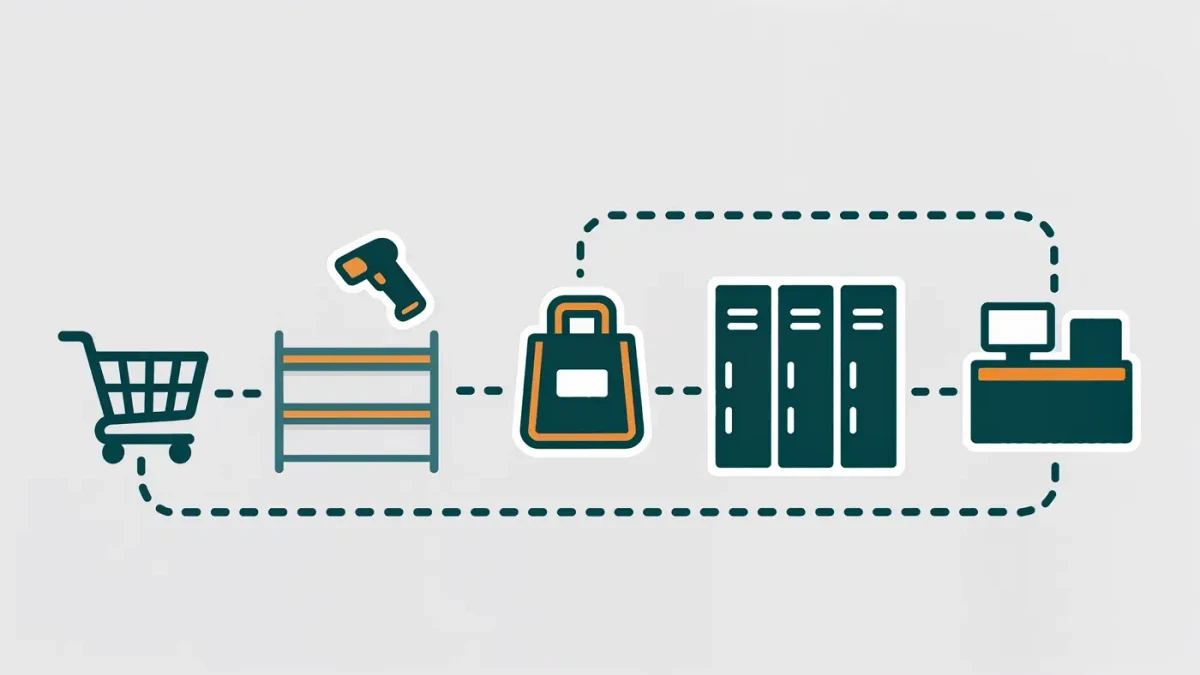
BOPIS — buy online, pick up in store — hands the final delivery leg to the customer's car, hence the promotion. The saving is not free: each pickup order costs a store an estimated $2 to $6 to assemble, before counting no-shows. According to operations studies, in-store handling of a pickup order often approaches the cost of shipping it.
How does a BOPIS order actually get fulfilled?
The workflow runs through the store's existing operation, borrowed rather than built. A typical sequence:
- Order routing: the order management system selects a fulfilling store based on stock position, distance, and workload, and pushes a pick task to the floor.
- Picking: a sales associate, often between other duties, walks the pick path, scanning units to confirm the right size and colour — the step where substitution errors originate.
- Staging: picked goods go to a holding area, bagged and labelled with an order number, awaiting the customer.
- Notification and arrival: the customer receives a ready message and reports to a pickup point, counter, or locker.
- Verification and handover: staff match the customer to the order, check identity where policy requires, and close the transaction.
Each step consumes minutes of paid time. Benchmarks through 2025 commonly place total labour at ten to twenty minutes per order, concentrated in picking and handover, with wide variance by store layout.
What does a pickup order cost the store?
Component estimates make the cost stack visible:
| Cost element | Estimated range | Driver |
|---|---|---|
| Pick labour | $1–$3 | Store size, pick path, item location |
| Staging and handover labour | $1–$2 | Pickup-point design, staffing at counter |
| Consumables | $0.20–$0.60 | Bags, labels, printer paper |
| No-show restock | Amortised per order | Unclaimed rate, typically 5–15 percent of orders |
| System and integration | Fixed, small per unit | Order management and store fulfilment software |
Against this sits the avoided parcel: pick, pack, and ship from a distribution centre is generally estimated at $8 to $12 before last-mile delivery, so BOPIS saves the retailer several dollars per converted order — if the customer would otherwise have shipped. The complication is attach spending: a meaningful share of pickup customers add items during the visit, and estimates of attach spending range widely. Where attachment is strong, BOPIS behaves like a traffic programme; where it is weak, it is simply cheaper logistics.
Why do no-shows matter so much?
Every picked order is inventory removed from the floor, unavailable to other shoppers until its deadline expires. When the customer never arrives, the store performs the whole process in reverse — locating the order, unpacking, returning units to stock — and the labour doubles without revenue. Industry discussions through 2025 put unclaimed pickup rates between roughly 5 and 15 percent, varying by category and deadline policy, which is why retailers fight the number with shorter ready-time promises, reminder notifications, and automatic release of stock after a set window.
No-shows also distort the staging maths. Staging capacity is planned against peak pickup volume; a double-digit unclaimed rate effectively reserves a slice of that capacity for orders that will never be collected, squeezing the orders that will. Some chains respond by charging nothing but enforcing strict release windows, others by moving frequent no-show customers toward ship-to-home, where the abandonment costs nobody a walk to the counter.
Deadline design is the quiet lever. Too short, and customers abandon orders mid-process; too long, and staging areas fill with unclaimed bags. Most operators have converged on release windows measured in days rather than hours, with lockers and designated shelves absorbing the storage burden.
Related stories: What One Returned Garment Really Costs a Retailer to Process · Inside the Decompression Zone: Why the First Metres Sell Almost Nothing.
How does picking compete with selling?
The structural tension in BOPIS is labour identity. The person picking online orders is usually the person who should be selling on the floor, and every pick task is a visible trade of one against the other. Stores resolve it differently: some dedicate backroom staff to digital fulfilment, some run picks in the early morning before doors open, and some simply accept degraded floor service at peak — the chosen approach shows up directly in order accuracy and in the wait customers experience at pickup. Accuracy failures in picking — wrong size, wrong colour — convert a saved parcel into a worse outcome than shipping, because the customer has already made a trip and their frustration arrives in person, with a witness present.
Where the fulfilment happens is itself a decision with numbers attached. Back-of-store picking protects the sales floor but lengthens the pick path; floor picking shortens the walk and damages the shopping atmosphere. Retailers who model the trade-off usually find the answer differs by store size, which is one reason identical chains run visibly different pickup operations in different locations.
Peak season multiplies every one of these dynamics. During the November-December trading period, pickup order volume can double or triple while floor staff are simultaneously needed for selling, and the staging area becomes contested real estate between digital orders, customer service returns, and delivery intake. Retailers who survive the peak with the service intact typically do three things: they set a daily cap on pickup slots so the promise remains deliverable, they move assembly to hours when the floor is closed, and they staff a dedicated handover point so the queue for collection never merges with the till queue. Operators who do none of it discover the operational meaning of a broken promise at scale: the ready-in-two-hours message that arrives at hour five, the counter queue that costs the sale the order was meant to protect. BOPIS failures are unusually visible because they happen in front of other customers, at the moment of highest expectation.
Is BOPIS worth expanding?
The honest answer is that it depends on three measurable conditions: whether the store's pick path allows order assembly under fifteen minutes; whether pickup customers attach enough in-store spending to justify the labour; and whether the no-show rate is managed below the level where restocking erodes the parcel savings. Retailers meeting all three conditions treat BOPIS as genuinely profitable infrastructure. Those meeting none have built a discount on shipping that happens to cost their stores labour — and the difference between the two is operational, not strategic.