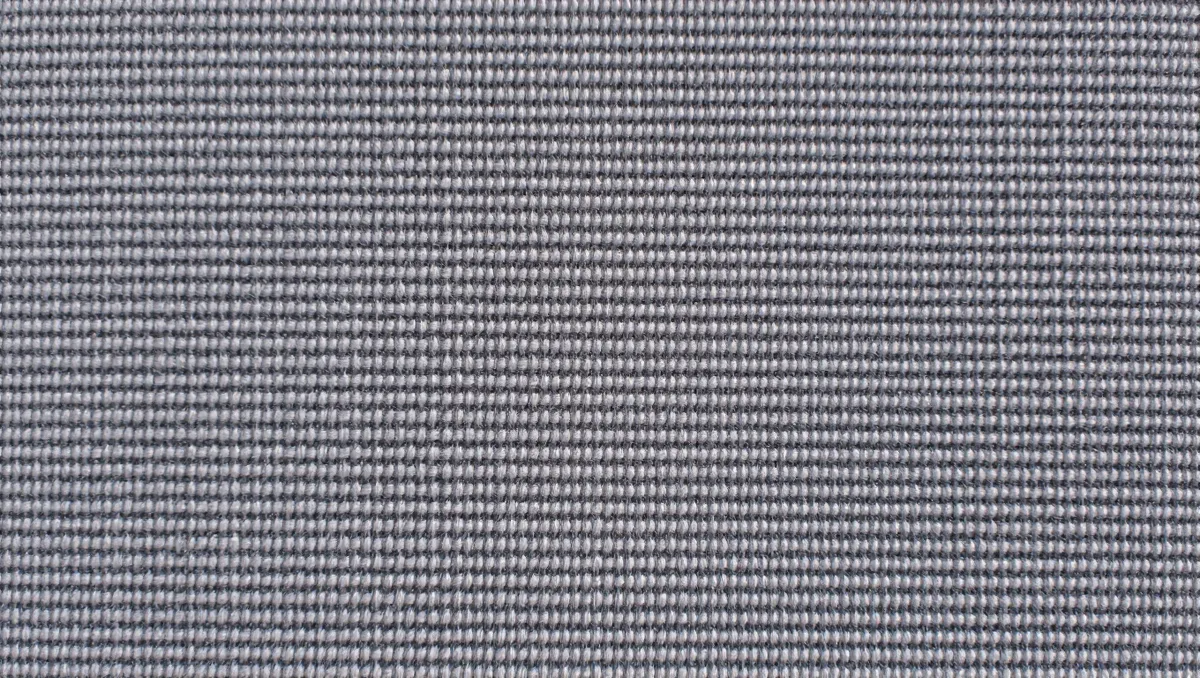
Fabric grain is the direction the threads run in a woven cloth, and it decides how a garment hangs, stretches and holds its shape. Cut a pattern piece with its grainline running the wrong way and the same fabric will drape differently, twist at the hem and sag where it should stay firm. Grain is not a finishing detail; it is part of the garment's structure.
Woven cloth is built from two sets of yarns crossed at right angles. The warp runs lengthwise down the roll, under high tension on the loom. The weft runs crosswise, woven over and under the warp. Each direction has its own personality, and a third one — the diagonal, called bias — behaves unlike either. A pattern's grainline arrow tells the cutting room which of these directions each piece must follow.
This piece sits in the wider design coverage of how garments are engineered, alongside explainers on pattern math and construction. Here the focus is the cloth itself: what each grain direction does, how pattern pieces are oriented before cutting, and why factories check grain before a single blade moves.
What are warp, weft and bias, and how does each behave?
The warp is the lengthwise set of yarns, held taut on the loom while the weft is woven through it. That tension matters. Warp-direction fabric has very little give and the greatest strength along its length, which is why selvage edges — the tightly woven finished edges that run parallel to the warp — barely stretch at all. The weft direction has slightly more yield. It is the looser of the two straight grains because the filling yarns are not held under the same constant tension.
Bias is any diagonal direction across the cloth, and the true bias is the 45-degree angle where warp and weft meet evenly. Cut on the bias, a woven fabric stops behaving like a grid. The diagonal lets the squares of the weave shear into diamonds, so the cloth gains stretch, clings as it falls and recovers when the stress is released. This is the property behind bias-cut dresses that skim the body without any elastic in the yarn. The same property is a hazard elsewhere: a bias-cut panel that should have been straight-grain will grow in length and twist in wear.
Knits complicate the picture. A single jersey has rows and columns of loops rather than two crossed yarn systems, and it stretches most across the width — from selvedge to selvedge — because a row of loops can open and close. For knits, the pattern's "greatest stretch" arrow plays the role the grainline arrow plays for wovens, and pointing it the wrong way produces a garment that either strangles or slumps.
How does a factory orient pattern pieces to the grain?
Every pattern piece carries a printed grainline arrow, and the rule is mechanical: that arrow must lie parallel to the selvage. The marker maker — the person who arranges all the pattern pieces onto the cutting layout like a jigsaw to minimize waste — may rotate pieces to save cloth, but never across the grainline. A sleeve, a front panel and a collar each get their own arrow, because the designer chose each direction for what that part must do.
The choices follow function. Bodies and sleeves are usually cut with the warp running down the length, so the garment resists the vertical stress of wear and keeps its length. Waistbands and cuffs are often cut with the warp running around the body, along the firmest direction, so they hold their shape instead of stretching out. Collar pieces and facings may be cut on the bias deliberately, so they can curve around a neckline without puckering. A hem facing cut on the bias will lie flat around a curved edge where a straight-grain version would bump and ridge.
Deliberate bias cutting is the exception that proves the discipline. A true bias skirt uses the diagonal on purpose, and the pattern accounts for the fact that the cloth will continue to drop over time — hems are often left to hang before finishing so the length settles. The engineering is in accepting the movement, not eliminating it.
What actually goes wrong when a piece is cut off-grain?
Off-grain cutting means the grainline arrow did not end up parallel to the selvage. The distortion shows up in three ways.
- Drape shifts. A front panel cut slightly off the lengthwise grain will not hang plumb. One side swings forward or back, and the asymmetry grows toward the hem, where a small angular error at the shoulder becomes a visible skew at the bottom edge.
- Stretch appears where it should not. A straight-grain piece has almost no give along the warp. Rotate it a few degrees and the diagonal component starts to work, so a neckline or an armhole that was drafted firm now gapes.
- Twisting in wear and washing. The cloth keeps trying to shear back toward its natural balance. Seams rotate around the leg or the body, and the hem migrates out of level — the same family of failure covered in the explainer on why hems twist and roll.
Fit suffers even when nothing looks wrong on the hanger. Ease allowance — the room built between body measurements and garment measurements, covered in detail in Ease Allowance: The Centimeters of Math That Decide Whether a Garment Fits — assumes the cloth behaves in the drafted direction. Off-grain cutting changes the fabric's effective stretch and recovery, so the measured ease and the worn ease stop matching. Readers following this should also see Ease Allowance: The Centimeters of Math That Decide Whether a Garment Fits.
Why do factories check grain before cutting?
Before a marker is laid, the cutting room checks whether the fabric itself is straight. Cloth can come off the loom, through dyeing and finishing, with the weft sitting at an angle to the selvage — a fault called bias skew — or bowed into a curve across the width. If pieces are cut against a skewed weft, the printed grainline and the actual yarn direction disagree, and the finished garment distorts no matter how carefully the marker was made.
The standard remedy is to straighten the grain before cutting: the cloth is relaxed, and the weft is trued back to a right angle with the selvage, either by nudging the fabric square by hand or by steaming and pressing it into alignment. Quality control then verifies that the printed grainlines on the marker sit parallel to the selvage before the lay is cut. Once hundreds of plies are cut at once, an orientation error is not one defective garment — it is a full batch.
This is why grain discipline is a factory control point rather than a sewing nicety. The checks happen before the irreversible step. Notches and control marks, covered in Notches and Control Marks: The Small Cuts That Keep Sewing Factories Honest, perform the same role later in the line: small, cheap verifications that keep a large process honest. We covered a connected angle in Notches and Control Marks: The Small Cuts That Keep Sewing Factories Honest.
What this means for how a garment earns its place
Grain direction is one of the quiet signals that separates careful production from careless production. A garment whose stripes and checks match at the seams, whose hem hangs level after washing and whose neckline stays put is usually a garment whose cutting room respected the grainline. None of that is visible on a hanger under store lighting, which is exactly why it is a useful thing to check: hold the garment up, look at whether vertical design lines hang plumb and whether patterned cloth lines up across seams.
The same logic runs through the rest of construction. Seam choices determine where strength and cost sit, as Seam Types Decoded explains, and interfacing decides whether a shoulder keeps its form, as covered in Why Shoulders Collapse. Grain is the first of these decisions because it is made before any sewing happens — it is decided at the cutting table, where it is cheapest to get right and most expensive to get wrong.
The takeaway
Warp, weft and bias give one fabric three different behaviors: firm along the length, slightly yielding across the width, elastic on the diagonal. Pattern grainline arrows assign each piece the direction its job requires, and factories verify both the cloth's grain and the marker's alignment before cutting because a batch-level error cannot be sewn back. When a garment hangs well years into its life, grain direction is one of the main reasons — a decision made before the first stitch, and one worth checking before the first purchase.
Sources: fabricmc.net · modrinth.com