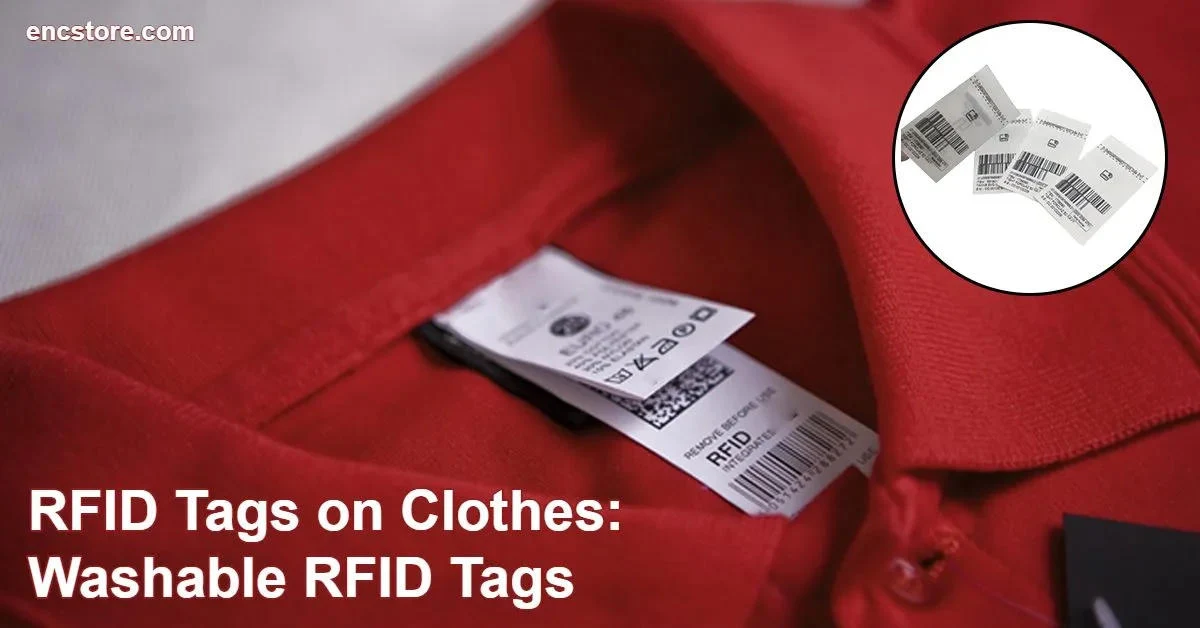
RAIN RFID is a passive radio tag, built to the GS1 EPC Gen2 and ISO/IEC 18000-63 standard, that a reader can power and read from a distance without a battery in the tag or a line of sight to it, letting a stockroom crew scan hundreds of garments in one sweep instead of counting them by hand. The technology is not new; what changed is that apparel supply chains built the item-level infrastructure to use it, according to GS1 US, the standards body that maintains the specification.
What Is RAIN RFID, and How Is It Different From a Barcode?
A barcode carries one piece of information — a SKU — and needs a clear optical line to a scanner held close to it, one item at a time. RAIN RFID, per GS1 US's supply-chain documentation, works instead through electromagnetic coupling: the reader's antenna emits radio energy, the tag's chip briefly draws power from that signal, and it responds with its own unique identifier, which under the EPC standard can distinguish one T-shirt from every other T-shirt of the same style, color and size ever made. That serialization is the practical difference from a barcode, which only identifies the style.
GS1 US describes RFID broadly as radio communication whose range depends on frequency, spanning roughly one centimeter up to nearly 1,000 meters across the technology's different bands; the passive ultra-high-frequency tags apparel retailers sew or stick into garments sit toward the shorter, cheaper end of that spectrum, typically read from a few meters, which is enough to sweep a rack or a doorway without unpacking a box. Because the reader does not need to see each tag individually, it can capture dozens of them simultaneously, even stacked inside a carton — the capability GS1 US credits with turning inventory counts into a “high-speed” process rather than an item-by-item one.
How Does a Tag Run for Years Without a Battery?
The standard defines two broad tag types, and apparel retail has settled almost entirely on one of them.
| Tag type | Power source | Typical apparel use |
|---|---|---|
| Passive | Powered by the reader's own electromagnetic field on each read; no internal battery | Sewn-in or hang-tag labels on individual garments; can function for up to 20 years, per GS1 US |
| Active | Carries its own internal power source and can transmit on a regular schedule | Rare at item level in apparel; more common on reusable containers or high-value asset tracking |
A passive tag's chip and antenna are cheap enough to embed in a paper hang-tag or sew into a care label, and because there is no battery to replace or degrade on a schedule, GS1 US says the tag can keep working for up to two decades — far longer than a garment's own retail life, which is one reason the tags have shown up woven into apparel labels rather than as an add-on component.
Who Has Actually Put RAIN RFID to Work in a Stockroom?
Decathlon is the case GS1 US points to as an early mover at scale: the sporting-goods retailer, per GS1 US's own case-study description, uses EPC-enabled RFID to uniquely identify its products worldwide, tagging items at the source rather than retrofitting them later in the supply chain. At the smaller end, apparel brand Southern Fried Cotton described the same shift in practical terms in a testimonial GS1 US published: “The RFID solution has made my life easier, and we have saved money by being more accurate in our shipments,” said Tracy Harrington of the company.
Label maker Avery Dennison, which supplies apparel brands with RFID-enabled hang-tags and care labels, positions the tags as giving retailers real-time stock visibility and traceability built into a label the garment already needs — a manufacturer's framing of the technology's value, not an independently verified figure, and worth reading as such.
What Did the Research on Getting the Data to Flow Actually Show?
The harder problem was never reading a tag — it was trusting the count that came back, and connecting it across every company that touches a garment before it reaches a shelf. Auburn University's RFID Lab, which has studied the business case and technical implementation of RFID in retail for more than two decades, ran an early version of that question in a study on RFID item-level quantity auditing for apparel supplier distribution centers, funded by GS1 US and the American Apparel and Footwear Association and conducted through 2011; it examined how RFID reduced shipping and inventory discrepancies inside a supplier's own distribution center and what it cost to reach high accuracy.
A later Auburn Lab proof-of-concept, the CHain Integration Project, ran from January to December 2019 with Nike, PVH Corp., HermanKay, Kohl's and Macy's as participants. It set out to connect serialized RFID data streams from source to store across separate companies, built on a Hyperledger Fabric blockchain foundation, on the premise that RFID's item-level serial numbers are the underlying data source any blockchain-based tracking system would need. The project is a proof-of-concept, not a shipped retail system, and Auburn's own materials frame it that way — evidence that the harder work of linking one retailer's tag reads to a supplier's and a factory's was, as of that pilot, still being tested rather than running at scale.
What This Changes for a Stockroom, Concretely
Put together, the sourced pieces describe a fairly narrow but real shift: passive UHF tags built to a shared GS1 standard, cheap and durable enough to live inside a garment's own label for its whole retail life, read in bulk without unpacking or aiming a scanner at each item. That is what let Decathlon tag at the source rather than after the fact, and what a small brand like Southern Fried Cotton says improved shipping accuracy enough to save money. What is not yet established by the sourced record is a single accepted number for how much apparel-wide inventory accuracy improves, or what a full stockroom retrofit costs a mid-size retailer — those figures were not present in the primary sources reviewed for this piece, and this article does not invent them.